
Why a Slower Market Is When Smart Buyers Move — And Why Lakewood Is Where They Move To
There is a specific kind of investor — and a specific kind of homebuyer — who understands something that most people get backwards.
The time to buy into a growing community is not when everyone is already talking about it. It is before they are. When the infrastructure investment is committed but not yet visible. When the population growth has data behind it but has not yet pushed prices to reflect what the community is becoming. When the market has softened enough that you can make a considered decision rather than a panicked one.
That window — the one that looks like a pause but is actually an entry point — is exactly where Strathmore, Alberta sits in July 2026.
Here is the case.
Alberta is Canada's growth story right now — and it is not close
Let’s start with the macro picture, because community-level investment decisions do not happen in a vacuum.
As of July 1, 2025, Alberta’s population crossed five million residents for the first time in its history — reaching 5,029,346. That milestone matters less than what is driving it.
Alberta has been the top destination for people moving within Canada for twelve straight quarters — three full years — gaining 6,187 people through interprovincial migration in Q2 2025 alone. As of the fourth quarter of 2025, that streak had extended to fourteen consecutive quarters, recording the largest net gain from interprovincial migration of any province in Canada.
Ontario and BC are not just holding steady. Ontario lost 6,154 residents to interprovincial migration from April through June 2025 alone — its fifteenth straight quarter of net losses. Those people are not disappearing. An estimated 8,780 Ontarians moved to Alberta in just three months of 2025 — and the reason, according to ATB Financial, is not an energy boom this time. It is relative housing affordability and a wider range of opportunity.
Alberta’s population is projected to reach seven million by 2051 — adding roughly 1.9 million residents over the next 26 years — with 81% of that growth driven by migration.
That is not a bubble. That is structural, sustained demand for housing in this province.
Strathmore's specific growth is ahead of the headline
Within that Alberta growth story, Strathmore is one of the communities quietly doing exactly what the projections suggest: growing, investing, and building the infrastructure that holds property value over time.
Strathmore’s population reached 16,416 in 2025 — a 9.73% increase in five years, and 1.74% growth year over year. From 14,084 in the 2016 census to 16,769 estimated in 2026, the town has added roughly 2,700 residents in a decade — steady, compounding growth that reflects genuine demand rather than a single-year spike.
In 2024 alone, $27 million in building value was added to Strathmore, with 37 new industrial, commercial, and institutional permits issued. That number is the private sector voting with capital on what they believe the town is becoming.
Two private sector projects cumulatively valued at $290 million are proposed or under construction in Strathmore right now — including Prairie Sky Data Solutions, which chose Strathmore specifically to build a specialised AI-compatible data centre. That is not a company betting on a small town. That is a company betting on infrastructure, connectivity, and a growing skilled workforce within commuting distance of Calgary.
The provincial government’s Budget 2026 commits $28.3 billion over three years to strengthen infrastructure across Alberta — directly addressing the rapid population growth that is putting pressure on services in communities like Strathmore. A $5 million investment in the Strathmore and Area Agricultural Society for the construction of the Western Events and Cultural Centre is already committed — adding to the town’s identity as a destination, not just a pass-through.
This is what an investment thesis looks like before the price catches up to the value.
What a slower market actually means
Let us be clear about something: a slower real estate market is not the same as a bad one.
The frenzy of 2021 and 2022 — when buyers were waiving inspections, offering over asking on the same day the listing appeared, and making $700,000 decisions in a 48-hour window — was not a healthy market for buyers. It was a pressured one.
A slower market means you can visit a community twice. Drive it on a Tuesday morning and a Thursday evening. Walk the paths. See the school, the hospital, the golf course. Think about what your life would actually look like there.
More importantly, a slower market means the price reflects the present, not the frenzy version of the future. You are buying at today’s value, in a community building toward tomorrow’s.
The buyers who consistently build wealth through real estate are not the ones who buy when everyone is excited. They are the ones who buy when everyone is cautious — into communities with genuine structural advantages that do not depend on market sentiment to hold their value.
Why community permanence is the variable that matters
Here is the distinction that separates a good investment from a speculative one: the difference between price and value.
Price is what you pay the day you sign. Value is what the home is worth because of everything that surrounds it — the infrastructure, the lifestyle infrastructure, the permanence of the community’s advantages.
A home in a community with parks, golf courses, a lake, a hospital, quality schools, and 24 kilometres of connected pathways is not worth the same as a home in a community with none of those things — even if the listing prices are identical today. One community holds its value when the market softens. The other does not.
This is the Lakewood argument.
Lakewood, Strathmore — what premium actually looks like east of Calgary
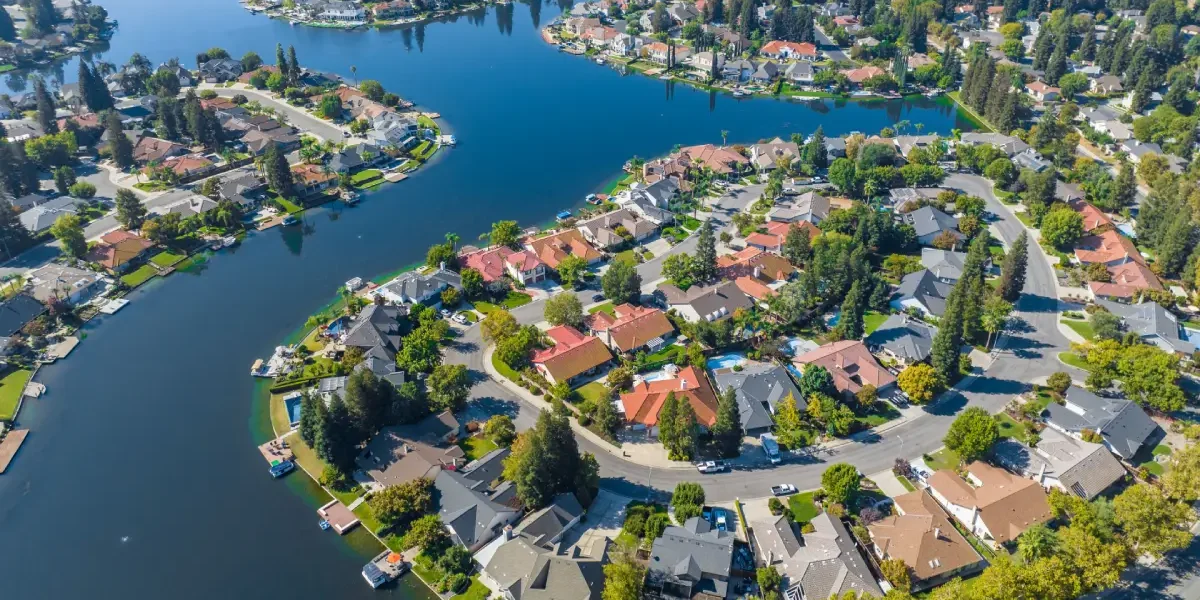
Lakewood is positioned between two golf courses, with an 18-acre recreational lake, 13 acres of scenic storm ponds, walking paths, and green space. The community connects to over 24 kilometres of pathways, with lakefront walking routes and parks at the doorstep.
The Strathmore area has three golf courses within convenient distance, including the Strathmore Golf Club, which has been operating for nearly a century. Golf courses are not just an amenity. They are a permanent land use that protects sightlines and prevents the kind of dense infill development that erodes neighbourhood character over time. The greens around Lakewood are not going anywhere.
The town has a hospital. It has schools. It hosts the Strathmore Stampede — an annual event that draws thousands of people and is woven into the town’s cultural identity in a way that cannot be manufactured. These are not features added to attract buyers. They are the features that have made this community function well for decades.
Lakewood Meadows features over 40 acres of ponds, wetlands, and water features, with more than 3.5 kilometres of scenic shoreline. In the summer, residents paddle-board and kayak from within their own community. In winter, the lake surface becomes a skating rink. These are the qualities that make people stay — and that make resale buyers want in.
What Strathmore looks like in five years
Based on what is already committed and underway, here is a reasonable picture of Strathmore in 2031:
Population approaching 20,000 — representing roughly 20% growth from today at the current trajectory. A new AI-compatible data centre operational, bringing technology sector employment to the area. The Western Events and Cultural Centre fully built and attracting regional events and visitors. The Strathmore Motor Products Sports Centre established and generating the kind of community activity that makes a town feel like a destination rather than a stopover.
Schools expanded. Medical services expanded. Retail following the rooftops, as it always does. And the 24 kilometres of pathways connecting it all — already there, already walkable, the infrastructure that does not need to be promised because it is already built.
The buyers who purchase in Lakewood today are buying into the community as it is — with all of those advantages already in place — at prices that do not yet fully reflect what the community is becoming.
That is the investment thesis. And it is grounded not in optimism but in what the data already shows.
The value vs price call
Every real estate decision comes down to the same question, whether you are a first-time buyer or a seasoned investor: are you paying a price, or are you recognising value?
A home in Lakewood, Strathmore — in a premium waterfront community, between two golf courses, connected to 24 kilometres of pathways, beside a hospital, near schools, in a growing town receiving meaningful government and private investment, 45 minutes from downtown Calgary on Highway 1 — is a different asset than a home in a community with none of those characteristics.
The price tag may be similar today. The value is not.
The buyers who recognise that distinction before the broader market does are the ones who, five years from now, look back at 2026 not as the year the market was slow but as the year they made a clear-eyed decision in a community that was worth believing in.
View Available Homes
See available homes in Lakewood, Strathmore.
Book a 30-minute call
Book a 30-minute call to talk through the investment case for your specific situation.
NOTE :
- Add pull quote display for: “Price is what you pay the day you sign. Value is what the home is worth because of everything that surrounds it.”
- Feature image: Lakewood aerial or pond/pathway photo
- Internal links: Lakewood page, Contact page, Series pages
- Add citation sources in footer or as hover references for the statistics used
- Related posts: Link to Blog 1 (GST Rebate) and Blog 2 (New Build vs Resale)
- This post qualifies for Article schema markup — add author name and publish date